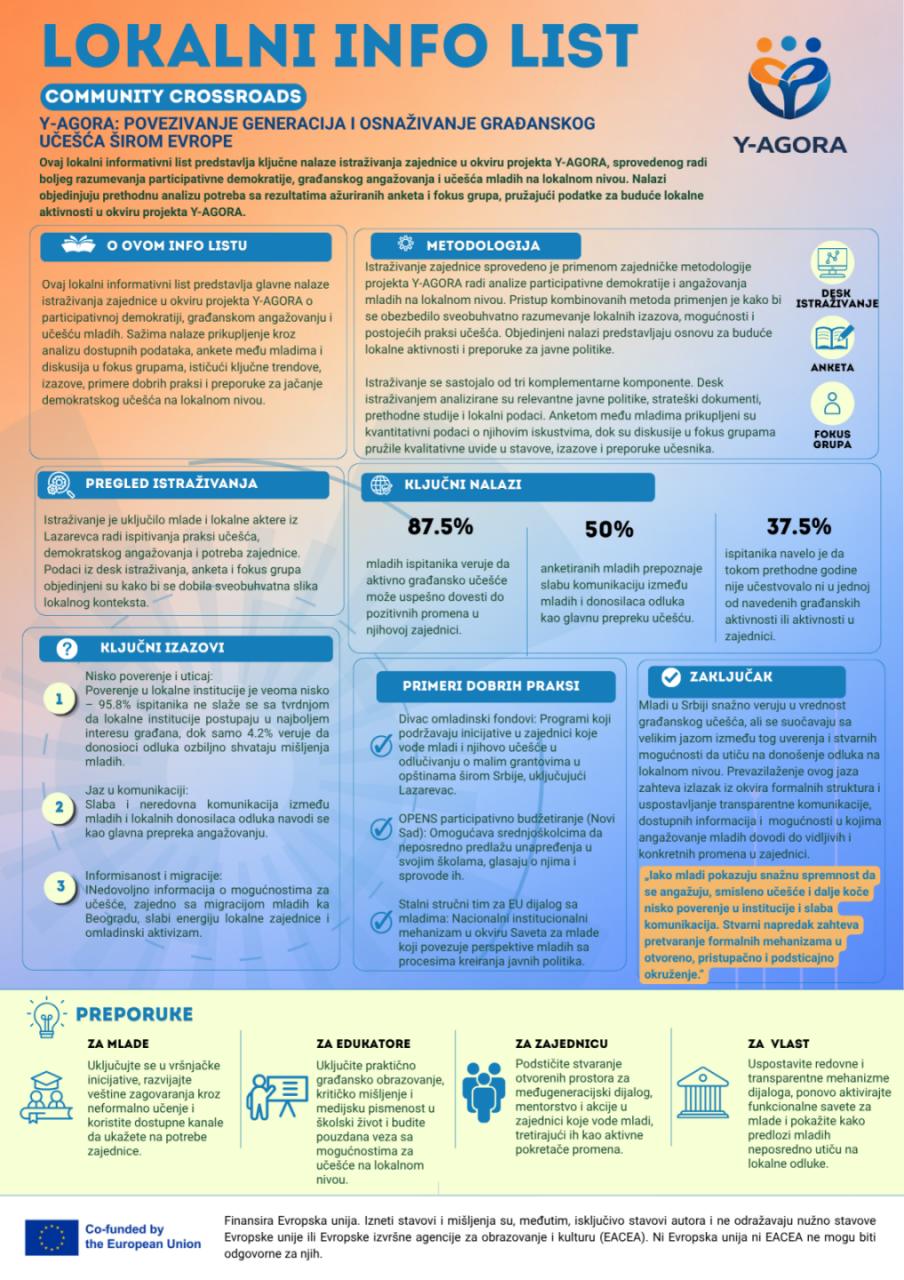



This local fact sheet presents key findings from community research within the Y-AGORA project, conducted to better understand participatory democracy, civic engagement, and youth participation at the local level. The findings combine previous needs analysis with the results of updated surveys and focus groups, providing data for future local activities within the Y-AGORA project.
Research Methodology
Community research was conducted using the shared methodology of the Y-AGORA project to analyze participatory democracy and youth engagement at the local level. A mixed-methods approach was applied to ensure a comprehensive understanding of local challenges, opportunities, and existing participation practices. The research consisted of three complementary components:
- Desktop research: Analysis of relevant public policies, strategic documents, previous studies, and local data.
- Survey: Collecting quantitative data from young people about their experiences.
- Focus groups: Qualitative insights into participants’ attitudes, challenges, and recommendations.
The research included young people and local stakeholders from Lazarevac to examine participation practices, democratic engagement, and community needs.
Key Findings (Statistics)
- 87.5% of young respondents believe that active civic participation can successfully lead to positive changes in their community.
- 50% of surveyed youth recognize poor communication between youth and decision-makers as the main barrier to participation.
- 37.5% of respondents stated that during the previous year they did not participate in any of the listed civic or community activities.
Key Challenges
- Low trust and impact: Trust in local institutions is very low – 95.8% of respondents disagree with the statement that local institutions act in the best interest of citizens, while only 4.2% believe decision-makers take young people’s opinions seriously.
- Communication gap: Poor and irregular communication between youth and local decision-makers is cited as the main barrier to engagement.
- Information and migration: Insufficient information about opportunities in Belgrade weakens the energy of the local community and youth activism.
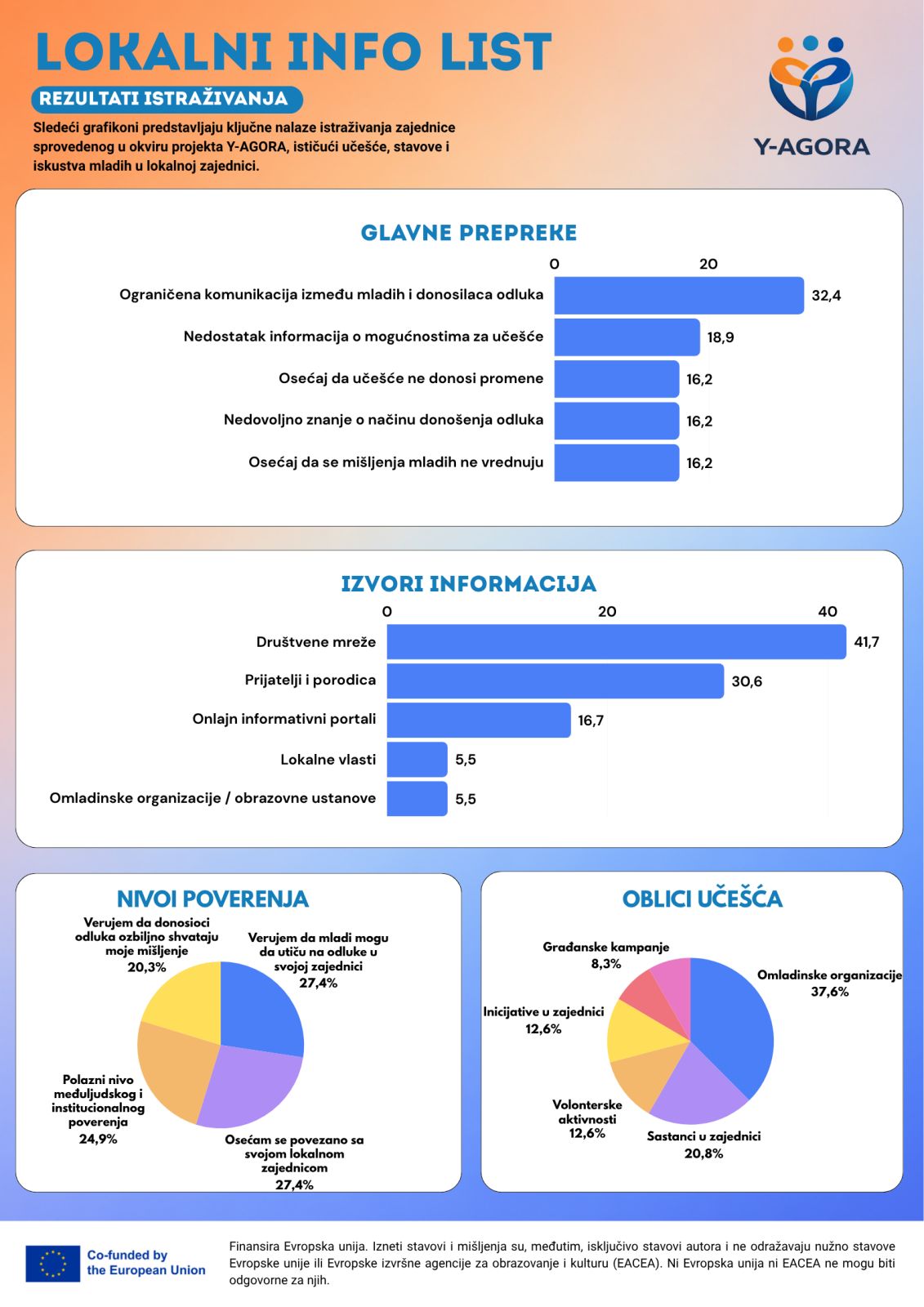
Research Results (Additional Overview):
- Main barriers: Limited communication between youth and decision-makers (32.4%), lack of information about participation opportunities (18.9%), feeling that participation brings no changes (16.2%), insufficient knowledge about decision-making processes (16.2%), and the feeling that youth opinions are not valued (16.2%).
- Sources of information: Social media (41.7%), friends and family (30.6%), online news portals (16.7%), local authorities (5.5%), and youth organizations / educational institutions (5.5%).
- Forms of participation: Youth organizations (37.6%), community meetings (20.8%), volunteering activities (12.6%), community initiatives (12.6%), and civic campaigns (8.3%).
Examples of Best Practices
- Divac Youth Funds: Programs supporting community initiatives led by youth and their participation in small grant decision-making across municipalities in Serbia, including Lazarevac.
- OPENS Participatory Budgeting (Novi Sad): Enables high school students to directly propose improvements in their schools, vote on them, and implement them.
- Permanent Expert Team for EU Youth Dialogue: A national institutional mechanism within the Youth Council that connects youth perspectives with public policy-making processes.
Conclusion and Recommendations
Young people in Serbia strongly believe in the value of civic participation, but they face a large gap between that belief and actual opportunities to influence decision-making at the local level. Bridging this gap requires moving beyond formal structures and establishing transparent communication, accessible information, and opportunities where youth engagement leads to visible and concrete changes in the community.
„Although young people show a strong willingness to engage, meaningful participation continues to be hindered by low trust in institutions and poor communication. Real progress requires transforming formal mechanisms into an open, accessible, and supportive environment.“
Sector Recommendations:
- For youth: Get involved in peer initiatives, develop advocacy skills through non-formal learning, and use available channels to highlight community needs.
- For educators: Integrate practical civic education, critical thinking, and media literacy into school life, and serve as a reliable bridge to local participation opportunities.
- For the community: Encourage the creation of open spaces for intergenerational dialogue, mentoring, and youth-led community actions, treating youth as active change-makers.
- For authorities: Establish regular and transparent dialogue mechanisms, reactivate functional youth councils, and demonstrate how youth proposals directly influence local decisions.
Community crossroads
Results of researching